The one thing to know:
Rainbows are natural optical phenomena that occur when sunlight interacts with water droplets in the atmosphere, creating a spectrum of colors.
- 1Rainbows are formed by the interaction of sunlight and water droplets.
- 2Light is refracted, reflected, and then refracted again inside each droplet, separating white light into its constituent colors.
- 3The specific angle at which we view these separated colors determines what we see as a rainbow.
Tap a part to jump there
Part 1 of 5Think of it like:
Imagine a prism, which splits white light into colors. Each tiny raindrop acts like a miniature prism, bending and separating the sunlight into its individual hues.

Key idea: Rainbows are formed by sunlight interacting with water droplets through refraction, reflection, and dispersion.
A rainbow is one of nature's most beautiful optical displays, a colorful arc that appears in the sky. To understand how it forms, we need to look at how interacts with in the atmosphere. It is a combination of several physical processes: refraction, reflection, and dispersion of light.
The key ingredients for a rainbow are sunlight and water droplets, typically from rain. You usually see a rainbow when the sun is behind you and rain is in front of you. This specific positioning is crucial for observing the phenomenon.
“The sun behind you, rain in front of you, and a little bit of magic in the air: that is the recipe for a rainbow.”
Quick check
What are the two main ingredients needed for a rainbow?
Light Enters the Water Droplet: Refraction
Key idea: Sunlight refracts, or bends, as it enters a water droplet, with different colors bending at different angles.
The first step in rainbow formation is . When sunlight, which appears white, enters a water droplet, it slows down and changes direction. This bending of light is called refraction. Different colors of light travel at slightly different speeds through water, so they bend at slightly different angles.
Think of it like a car hitting mud at an angle: one side of the car slows down before the other, causing the car to turn. Similarly, light bends as it enters the water droplet.
“Each tiny water droplet acts as a miniature prism, beginning the separation of white light into its vibrant components.”
Light Bounces Back: Reflection
Key idea: Light reflects off the back inner surface of the water droplet, sending the separated colors back towards the observer.
After entering the water droplet and refracting, the light travels to the back of the droplet. Here, it hits the inner surface and bounces back. This process is called . For a primary rainbow, the light undergoes one internal reflection.
This reflection is what sends the light back towards your eyes, allowing you to see the rainbow. Without this internal bounce, the light would simply pass through the droplet and continue on its way.
Light Exits and Spreads Out: Second Refraction and Dispersion
Key idea: Light refracts again upon exiting the droplet, further dispersing colors and directing them to the observer's eye at specific angles.
Finally, as the light exits the water droplet and re enters the air, it refracts a second time. This second refraction further separates the colors and directs them towards the observer's eye. Because each color bends at a slightly different angle, they emerge from the droplet at different angles.
This separation of white light into its constituent colors is known as . Red light bends the least, and violet light bends the most. This is why red is always on the outside of a primary rainbow and violet is on the inside.
“The magic of dispersion ensures that each color finds its unique place in the rainbow's arc, from fiery red to deep violet.”
Quick check
What three processes does light undergo inside a water droplet to form a rainbow?
Seeing the Arc: The Angle of View
Key idea: The arc shape of a rainbow is formed by the collective effect of millions of water droplets, each sending specific colors to the observer's eye at precise angles.
The reason we see an arc of colors, rather than just a single point of light, is due to the specific angles at which these colors emerge from the water droplets. For a primary rainbow, red light is most intensely seen at an angle of about 42 degrees relative to the incoming sunlight, and violet light at about 40 degrees.
Millions of water droplets are involved, each refracting, reflecting, and dispersing light. We see the combined effect of all the droplets that are positioned at the correct angle relative to our eyes and the sun. The arc shape is because all the droplets that contribute to the rainbow lie on a cone, with your eye at the apex and the sun's rays forming the axis.
Why does this matter?
- Understanding rainbow formation helps us appreciate the beauty and complexity of natural optical phenomena.
- It demonstrates fundamental principles of physics, such as the behavior of light (refraction, reflection, and dispersion), in an everyday context.
Ask Baiku
Ask a question and Baiku will answer simply 🙂
⚡ Tap for an instant answer
Test yourself
1 / 10What two natural elements are essential for the formation of a rainbow?
Can you explain these?
Try to explain each in your own words, without looking. The ones you stumble on are exactly where to re-read.
- 1Light interaction with matter
- 2Properties of light (refraction, reflection, dispersion)
- 3Atmospheric conditions for optical phenomena
- 4Human perception of light and color
Turn this into a learning journey
Go from this one topic to real understanding of Physics, a step-by-step path you can track and finish.
Build my journey →Go deeper into Physics
Read these in order to build a real feel for Physics.
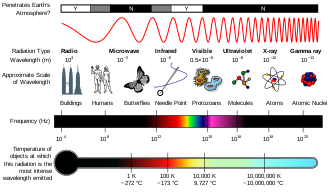
Electromagnetic spectrum
Range of frequencies or wavelengths of electromagnetic radiation
Optics
Branch of physics that studies light

List of atmospheric optical phenomena
Atmospheric optical phenomena include:Afterglow Airglow Alexander's band, the dark region between the two bows of a double rainbow. Alpenglow Anthelion Anticrepuscular rays Aurora Belt of Venus Brocken Spectre Circumhorizontal arc Circumzenithal arc Cloud iridescence Crepuscular rays Earth's shadow Earthquake lights Glories Green flash Halos, of Sun or Moon, including sun dogs Haze Heiligenschein or halo effect, partly caused by the opposition effect Ice blink Light pillar Lightning Mirages Monochrome Rainbow Moon dog Moonbow Nacreous cloud/Polar stratospheric cloud Rainbow Sprite (lightning) Subsun Sun dog Tangent arc Tyndall effect Upper-atmospheric lightning, including red sprites, Blue jets, and ELVES Water sky.

Electromagnetic spectrum
Full range of electromagnetic radiation frequencies