The one thing to know:
Systems biology helps us understand how all the tiny parts of living things work together as a team to make life happen.
TL;DR
- 1Systems biology looks at how all the parts of a living thing (like genes, proteins, and cells) work together, instead of just studying them one by one.
- 2It uses computers and math to build models that show how these parts interact and what happens when they do.
- 3This way of thinking helps scientists understand big problems like diseases and how to make better medicines or grow healthier food.
Think of it like:
Think of it like understanding how a whole football team plays. Instead of just watching one player (like the quarterback) all the time, systems biology watches how all the players (like the offense, defense, and special teams) work together, pass the ball, and make plays to win the game.
Imagine trying to understand how a car works by only looking at one tiny screw. You wouldn't really know how it drives, right? is a special way of studying living things, like plants, animals, or even tiny cells, by looking at all their parts working together as a big team. Instead of just studying one gene or one protein, scientists use computers and math to figure out how all these different pieces interact and what happens when they do. It's like seeing the whole picture, not just one small part.
For a long time, scientists mostly used a way of studying called "". This meant they would break things down into smaller and smaller pieces to understand them. For example, to understand a cell, they might study just one type of protein. This was very helpful and taught us a lot!
But some smart people, like Jan Smuts, thought it was also important to look at the "" – how the whole thing works together. He said that when many parts come together, they can do new things that you wouldn't expect from just looking at the individual parts. Think of it like a bicycle: you can understand each part (wheels, pedals, chain), but to know how it rides, you need to see them all connected and working together. Systems biology tries to do both: understand the small parts and how they create the big picture.
“It's like seeing the whole picture, not just one small part.”
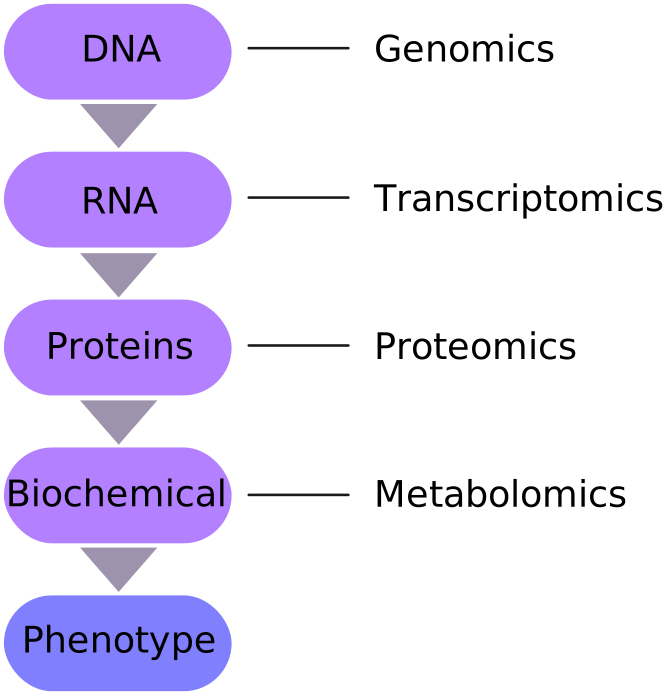
To understand these complex systems, scientists need lots of information. They use special tools to collect huge amounts of data about genes, proteins, and other tiny molecules. This is called "" data. Imagine taking a super detailed snapshot of everything happening inside a cell at once!
Once they have all this data, they use computers and math to build "". These models are like mini-simulations or maps that show how everything is connected and how it might behave. They can then test ideas (called "") using these models, almost like playing a video game to see what happens if you change one thing.
There are two main ways scientists build these models: "" and "".
The top-down approach is like looking at a city from an airplane. You see the whole city first, then try to figure out how the different neighborhoods and roads connect. Scientists look at the whole system's behavior first, then try to find the smaller parts that cause it.
The bottom-up approach is like starting with one house in the city, understanding how it works, then adding another house, then a street, until you build up to understand the whole city. Scientists start with small, detailed parts, understand how they work, and then combine them to see how the bigger system behaves.
“Models are like mini-simulations or maps that show how everything is connected and how it might behave.”
Systems biology is super helpful in many areas. For example, in medicine, it helps us understand diseases better. By seeing how all the parts of a sick cell interact, scientists can find new ways to create "" that fix specific problems without harming healthy parts.
It's also used in farming to grow healthier plants and in understanding how our bodies react to different foods. Imagine making a plant stronger against bugs or making food more nutritious by understanding its systems!
Even though systems biology is amazing, it's also quite tricky! One big challenge is dealing with the huge amount of data. It's like having a library with millions of books and trying to read them all at once.
Another challenge is making sure all the different computer models and ideas from different scientists fit together. It's like everyone building a different piece of a giant puzzle, and then trying to make them all connect perfectly. Scientists are working hard to make these tools even better, often using "" to help them make sense of everything.
Why does this matter?
- It helps doctors find better ways to treat diseases like cancer by understanding how all the tiny parts of a sick cell are misbehaving.
- It can lead to healthier food and stronger plants by showing scientists how to improve crops.
- It helps us understand how our own bodies work, from how we digest food to how our brains think, by looking at the big picture of all our biological systems.
Ask Baiku anything about this article
Ask a question and Baiku will answer in plain English 🙂


