The one thing to know:
Cosmology is like being a super detective trying to figure out everything about our amazing universe, from how it started to what might happen to it in the very far future!
TL;DR
- 1Cosmology is the study of the whole universe, its beginning, how it works, and its future.
- 2Scientists like astronomers and physicists, along with thinkers called philosophers, all study cosmology.
- 3The Big Bang theory is the main idea for how our universe started and grew.
Think of it like:
Think of it like trying to understand a giant, never-ending storybook. Cosmology is reading every single page, from the very first word to the very last, to understand the whole plot, all the characters, and how it all ends.

Have you ever looked up at the night sky and wondered how big it is, or how it all began? That's what is all about! It's a super big word that comes from ancient Greek words meaning 'the universe' and 'study of'. So, cosmology is simply the study of the entire , or the 'cosmos'.
People have been wondering about the universe for a very long time. In the past, people used stories and beliefs to explain how the world came to be. But today, scientists like and use special tools and smart ideas to learn about it. Even some philosophers, who are people who think deeply about big questions, also study cosmology. It's a huge puzzle that many different kinds of smart people are trying to solve!
When we talk about scientific cosmology, we're focusing on how the universe started, how it's changed over time, and what it's made of. It's like trying to make a timeline for everything that has ever happened in space! Scientists want to know about its huge structures, like galaxies, and how everything moves around.
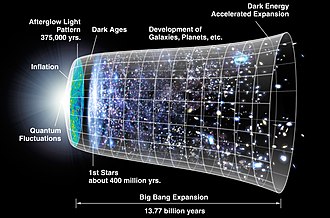
The most popular idea for how our universe began is called the . This idea says that our universe started super small and then expanded very, very quickly. It's still expanding today! Scientists believe the universe is about 13.8 billion years old. That's a lot of birthdays!
One cool thing about looking at space is that you're also looking back in time. Because light takes time to travel, when you see a star far away, you're seeing it as it was a long time ago. It's like a time machine!
“When we look out in space, we look back in time.”
Long, long ago, people had different ideas about how the universe worked. Some thought the Earth was the center of everything, with the sun and stars going around it. This was called the geocentric system. But then, smart people like Nicolaus Copernicus, Johannes Kepler, and Galileo Galilei figured out that the Earth actually goes around the sun! This was a huge change in how people understood the universe.
Later, a super-smart scientist named explained why planets orbit the sun with his idea of . He showed that the same rules that make an apple fall to the ground also make planets move in space. This was a big step because it meant the laws of nature were the same everywhere in the universe!
In the 19th century, some tricky questions came up, like "Why is the night sky dark if there are so many stars?" and "Why doesn't gravity pull the whole universe into one big ball?" These questions made scientists think that maybe the universe wasn't infinite or unchanging.
A very important moment in cosmology happened in 1917 when shared his ideas about . This new way of thinking helped scientists understand how gravity works even better and how space and time are connected. It made them wonder if the universe was actually growing!
Soon after, scientists like Alexander Friedmann suggested that the universe was indeed expanding. Then, a big debate happened about whether those fuzzy patches in the sky were just clouds of gas or if they were other galaxies, far, far away from our own Milky Way. Edwin Hubble, another famous astronomer, used special stars to prove that they were indeed other galaxies, showing just how huge the universe really is!
These discoveries, along with finding something called the cosmic microwave background radiation (which is like an echo from the Big Bang), helped scientists confirm the Big Bang theory. It was like finding missing pieces to a giant puzzle!
“The universe is 13.8 billion years old and composed of 4.9% atomic matter, 26.6% dark matter and 68.5% dark energy.”
For a long time, people also used stories, myths, and religious beliefs to explain how the universe began and what happens after life. These are called religious or mythological cosmologies. They often tell stories about creation and what the end of the world might be like.
While these stories are important to many cultures, scientific cosmology uses observations and evidence to understand the universe. It's like the difference between a beautiful story and a detective trying to solve a mystery with clues.
Cosmology isn't just about science; it also makes us think about really big questions. Like, why is the universe here? What is it made of? Does it have a purpose? These are questions that scientists and philosophers both ponder.
Some questions, like "Does the universe have a purpose?" are hard to answer with just science. But thinking about them helps us understand our place in the huge, amazing cosmos.
Why does this matter?
- Understanding cosmology helps us know where we come from and how our planet fits into the grand scheme of everything.
- It inspires new technologies, like powerful telescopes and space missions, that help us explore and learn even more.
- It encourages us to think big and ask important questions about our existence and the mysteries of the universe.
Ask Baiku anything about this article
Ask a question and Baiku will answer in plain English 🙂