The one thing to know:
Asteroids are rocky, metallic, or icy space objects that orbit the Sun, mostly found between Mars and Jupiter.
TL;DR
- 1Asteroids are like small, rocky leftovers from when our solar system was forming, too small to be planets.
- 2Most asteroids live in a special 'belt' between Mars and Jupiter, but some can get close to Earth.
- 3Scientists study asteroids with spacecraft to learn about them, and even practice ways to protect Earth from them.
Think of it like:
Think of our solar system like a big kitchen where a cake (the Sun) and cupcakes (the planets) are being baked. Asteroids are like the crumbs and small bits of batter that didn't quite make it into a cupcake, floating around the kitchen.
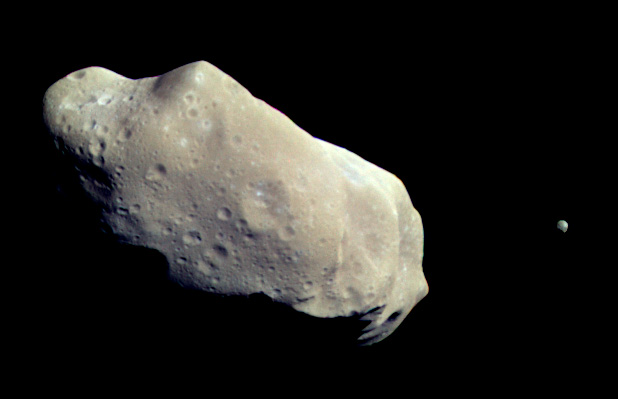
Imagine tiny worlds, much smaller than planets, floating in space. These are called ! They are like cosmic rocks, made of rock, metal, or ice, and they don't have an atmosphere (no air to breathe). They are bigger than tiny space dust but smaller than planets. Some are just little pebbles, while others, like , are almost 1000 kilometers wide – that's like driving across a whole country! When the Sun warms some of these objects, they can grow a tail, like a comet. But most asteroids don't have tails.
Most of the asteroids we know about live in a special neighborhood called the . This belt is located between the planets Mars and Jupiter. It's like a big, spread-out ring of space rocks! Even though there are millions of asteroids there, space is so huge that they are actually very far apart. If you were flying a spaceship through the asteroid belt, it would be pretty empty, not like a crowded field of rocks you see in movies. All the asteroids in this belt put together wouldn't even make up a moon as big as Earth's Moon. They usually take about 3 to 6 years to travel all the way around the Sun.
Scientists have been watching asteroids from Earth since 1801. But to get a really good look, we send special robots, called , to visit them. The Galileo spacecraft was the first to get a close-up picture of an asteroid! Since then, countries like the USA (NASA) and Japan (JAXA) have sent many missions. For example, the Hayabusa missions even brought tiny pieces of asteroids back to Earth! One exciting mission, called DART, even purposefully crashed a spacecraft into an asteroid named Dimorphos to see if we could push it a little bit. This was a test to see if we could protect Earth if a dangerous asteroid ever came our way.
“One exciting mission, called DART, even purposefully crashed a spacecraft into an asteroid named Dimorphos to see if we could push it a little bit.”
Asteroids Near Earth
Sometimes, asteroids can get very close to Earth. These are called (NEAs). Scientists are very interested in these because, in the past, some big space rocks have hit Earth. For example, many scientists believe a giant asteroid hit Earth a long, long time ago and caused the dinosaurs to disappear! Don't worry though, scientists are always looking for NEAs and keeping track of them.
There are different groups of NEAs based on their paths around the Sun. Some stay completely inside Earth's path, some cross it, and some stay mostly outside but can still come close. It's like different lanes on a racetrack around the Sun.
“Many scientists believe a giant asteroid hit Earth a long, long time ago and caused the dinosaurs to disappear!”
What Are Asteroids Made Of?
Asteroids come in all shapes and sizes! The biggest one is Ceres, which is so big it's also called a . It's round, just like Earth, and has different layers inside, like a planet. But most asteroids are much smaller and have weird, lumpy shapes. They are often just piles of rocks loosely held together.
Asteroids are made of different stuff. Some are mostly carbon (like charcoal), some are mostly metal (like iron), and some are mostly stone. Scientists can tell what an asteroid is made of by looking at the light it reflects. This helps them sort asteroids into different types, like C-type (carbon-rich), M-type (metallic), and S-type (stony).
“Asteroids come in all shapes and sizes!”
Water and Life's Building Blocks
Guess what? Some asteroids might even have water! Scientists have found ice on some asteroids, and even water vapor (like steam) coming from Ceres. This is super interesting because water is needed for life. It also makes scientists wonder if asteroids might have brought some of the first water to Earth a long time ago.
Asteroids can also have special ingredients called . These are like the building blocks for life, such as sugar molecules and parts of DNA. Some scientists think that asteroids crashing into early Earth might have delivered these important ingredients, helping life to start here.
Exploring and Using Asteroids
Scientists have learned a lot about asteroids by looking at them with telescopes and sending spacecraft. But it's hard to see them clearly from Earth because they are so far away and small. Spacecraft can fly right up to them and take amazing pictures, collect samples, and even measure how heavy they are. This helps us understand what they are made of and how they move.
One day, people might even try to mine asteroids! This means taking valuable metals or water from them. It could be useful for building things in space or getting resources that are rare on Earth. It's like a treasure hunt in space!
Protecting Earth
Since asteroids can sometimes hit Earth, scientists are working on ways to protect our planet. This is called . One idea is to gently push an asteroid off course, like the DART mission tried. Another idea is to break it into smaller pieces that would burn up harmlessly in our atmosphere. These plans are like having a cosmic shield for Earth, just in case!
It's important to remember that most asteroids are not dangerous, and scientists are doing a great job of finding and tracking them. So, you don't need to worry about an asteroid hitting Earth tomorrow, but it's smart to be prepared for the future.
Why does this matter?
- Asteroids can teach us about how our solar system formed, because they are like ancient leftovers from that time.
- Some asteroids contain water and special chemicals that might have helped life begin on Earth, and could be useful for future space travelers.
- Understanding asteroids helps us prepare and protect our planet from potential impacts, ensuring Earth stays safe for everyone.
Ask Baiku anything about this article
Ask a question and Baiku will answer in plain English 🙂


