The one thing to know:
Tiny living things called bacteria can be super tough, and understanding them helps us keep food safe and even makes us wonder about our own bodies!
TL;DR
- 1A milk carton at MIT was kept for 27 years, showing how some things can last a long time and inspire stories.
- 2Louis Pasteur discovered that tiny living organisms, not magic, cause food to spoil or ferment, leading to pasteurization.
- 3Probiotic teas often contain bacteria that are killed by boiling water, making their health claims questionable.
Think of it like:
Think of it like planting seeds. Some seeds are super tough and can survive a really hot oven, only to sprout and grow when they find good soil and water. Other seeds are delicate and will die if it gets too hot. Bacteria are a bit like these seeds – some are tough 'spores' that can handle boiling water, while others are easily killed.
Key idea: Even old or discarded things can hold interesting stories and lead to big scientific discoveries.
Imagine a milk carton that lived in a college dorm for 27 years! This isn't a fairy tale, but a true story from MIT. In 1994, a student bought some milk. Ten months later, he found it again. Instead of throwing it away, he threw it a birthday party! This milk, which was never put back in the fridge, became a legend. People would gather every year to celebrate its birthday. It eventually turned into a cloudy brown liquid, but it taught everyone that even old things can have amazing .
This idea of finding value in things usually thrown away reminds us of famous scientists like . He didn't just study wine; he also looked at the crystals that formed in wine barrels. These crystals helped him understand tiny living things and how they make food change, a process called . This discovery was super important for keeping our food safe!
For a long time, people thought that food like milk or grain just magically changed into things like yogurt or beer, or that it just spoiled on its own. They didn't know about the tiny creatures causing these changes. But Louis Pasteur proved them wrong! He showed that tiny living things, called or microbes, are responsible for these changes.
He did a famous experiment with special flasks that looked like swan necks. He boiled broth (a kind of soup) in these flasks to kill any microbes. One flask he left sealed, and it stayed clear. Another flask he broke the neck off, letting air and microbes in. That broth quickly became cloudy with growing bacteria. This showed that microbes from the air, not magic, made the broth spoil.
This discovery was great news for France and Napoleon! French wine was spoiling during shipping, costing a lot of money. Pasteur figured out that heating the wine gently could kill the microbes that made it go bad, without changing its taste. This process is now called , and it's why we can drink milk safely today. It kills bad bacteria but doesn't make the milk sterile (completely free of all life), so milk can still spoil eventually.
How much milk is pasteurized in the U.S. each year
“It was Pasteur who proved that living organisms were required for the transformations that took place during fermentation.”
Quick check
What did Louis Pasteur discover about fermentation and spoilage?
Key idea: While we fight bad bacteria with things like antibiotics and pasteurization, many bacteria are actually good for us, leading to the rise of probiotics.
Because of Pasteur, we now try to kill harmful bacteria in many ways. Think about taking when you're sick – about 7 out of 10 people in the U.S. used them in 2024! Or all the cleaning sprays and wipes you see in stores. There are also huge companies that make special machines to sterilize medical tools and keep our food safe.
But not all bacteria are bad! In fact, most of the bacteria around us and inside us are harmless or even helpful. There are at least 1,000 times more different kinds of good bacteria than bad ones. This idea has led to a big industry called the industry. Probiotics are living microorganisms that people eat on purpose, hoping they will help their health.
The word "probiotic" means "for life." So, when you eat a probiotic, you're basically eating good bacteria. We actually eat microbes by accident all the time, but probiotics are about choosing to eat specific ones. This industry wants us to believe that eating lots of these good microbes, often in special (and more expensive) foods, is always good for us.
Quick check
What is pasteurization and why is it important?
Key idea: Probiotic teas raise questions about whether the beneficial bacteria survive the brewing process and if they actually work.
I once bought a lemon ginger tea that said it had probiotics. I brewed it with boiling water, just like normal tea. But it tasted really bad, like powdery and strange! I wondered why they would put bacteria in tea if I was just going to boil them and kill them. It seemed a bit silly, or maybe even a trick.
My professor agreed that probiotic teas often taste bad. We wondered if the bacteria even survived the boiling water, and if they did, whether they actually helped people. So, we decided to do a little experiment in the lab to find out if the bacteria in the tea bags could survive boiling water.
The bacteria in that tea was a special kind called BC30™. It's considered safe and is found in many foods. To see if it would grow, we needed to know what it liked to eat and how warm it liked to be. We also needed to make sure it was safe to grow in the lab.
Key idea: An experiment showed that bacteria from probiotic tea could grow even after being steeped in boiling water, which was a surprising result.
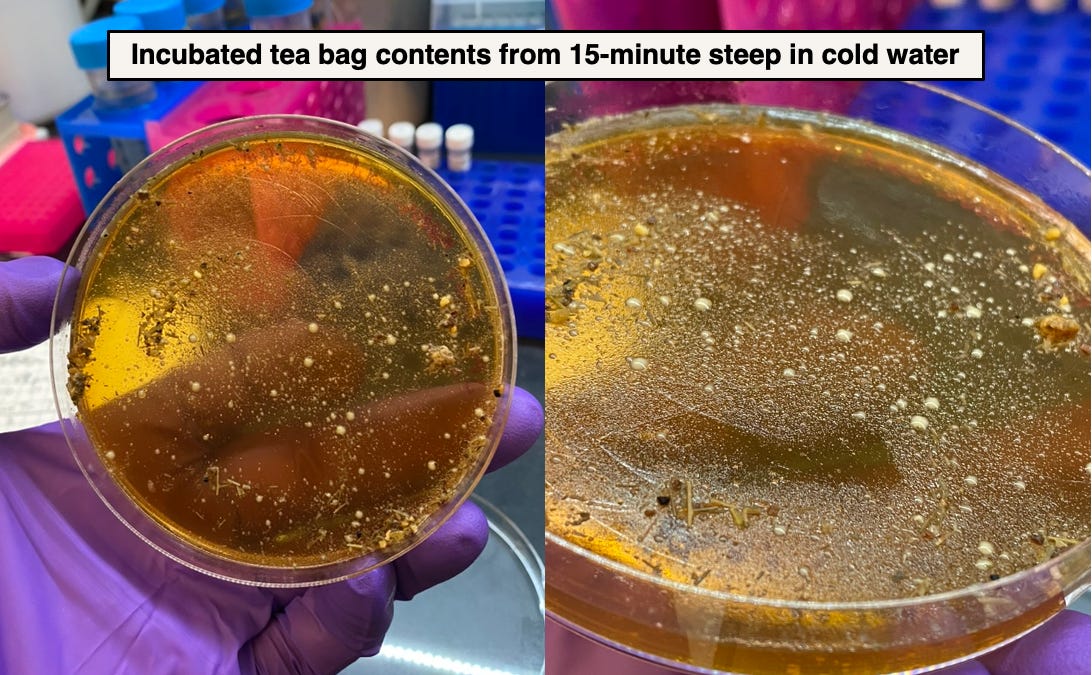
To test the tea, I made three different cups: one brewed normally with boiling water for 4 minutes, one brewed with boiling water for 15 minutes (like when you forget your tea!), and one cold-brewed. I also took some of the dry tea bag contents.
I then prepared special plates in the lab with a yummy food for bacteria called MRS agar. It's like a jello full of sugar and nutrients that bacteria love. I poured the tea from each cup onto these plates. I also sprinkled some of the dry tea bag contents onto other plates. Then, I put all the plates in a warm incubator, like a cozy bed for bacteria, and waited.
When I checked the plates two days later, I was surprised! There were tiny white dots, which were colonies of bacteria, growing on almost all the plates. Even the tea that had been steeped in boiling water had bacteria growing! The cold-brewed tea had some, but the boiling water tea actually had more. This was the opposite of what I expected!
To be super sure that the bacteria growing on the plates were actually BC30™, I did another test using their . It's like checking their unique fingerprint. And guess what? The tests confirmed it was indeed BC30™!
It turns out, BC30™ is a special kind of bacteria that can form . Think of spores like tiny, super-tough seeds. When conditions are bad, like when it's too hot or there's no food, these bacteria can turn into spores. These spores have a thick, protective coat that helps them survive extreme heat, dryness, and even some chemicals. This is why they could survive the boiling water in the tea!
When these spores find good conditions again, like on my warm, food-filled agar plate, they 'wake up' and start growing into active bacteria. This is how they are supposed to work as a probiotic: they stay dormant in the tea bag, survive the journey through your body, and then 'sprout' in your gut to do their helpful work.
Bacteria growth after different brewing methods (CFUs per mL)
“It turns out that BC30, like many of its relatives, is a spore-forming bacterium.”
Quick check
What are bacterial spores and how do they help bacteria like BC30™ survive?
Key idea: Even tough bacteria might not be effective as probiotics if the amount consumed is too small or if they don't survive and thrive in the gut.
Even though these bacteria can survive boiling water, there's a catch. Many studies about BC30™ used a huge amount of bacteria – about 1 billion spores every day. My tea experiment showed that a normal cup of probiotic tea only had about 30,000 bacteria. That's way, way less than what's used in the studies! So, it's not clear if drinking probiotic tea actually gives you enough bacteria to make a difference.
Also, scientists are still learning if these bacteria even make it through our stomach and intestines alive, or if they actually do anything helpful once they get there. Some studies say they don't survive, while others say some do. It's a complicated puzzle!
It's important to remember that while BC30™ is safe, it's not a normal resident of our gut. It's a soil bacterium. The world of bacteria inside our bodies, called the , is very complex. We don't even fully know what a "healthy" gut microbiome looks like yet, and it can be different for everyone. So, adding just one type of bacteria might not always be the best solution for tummy troubles.
Key idea: Curiosity and asking questions about everyday things can lead to important scientific discoveries and a deeper appreciation for the microbial world.
Even with all these questions, studying bacteria is amazing. When you see a tiny dot of bacteria growing on a plate, it's actually made up of millions or even billions of individual cells! It makes you wonder about all the tiny life around us.
The story of the MIT milk and the probiotic tea reminds us that it's important to be curious and ask questions. Sometimes, the most interesting discoveries come from looking closely at things we might usually ignore or throw away. Who knows, maybe the next big scientific discovery will come from someone just like you, wondering about something small but important!
Why does this matter?
- Understanding bacteria helps us keep our food safe to eat and prevents us from getting sick from spoiled food.
- Learning about probiotics helps us make smart choices about what we eat and drink, especially when companies make health claims.
- Being curious about small, everyday things can lead to big discoveries, just like it did for Louis Pasteur and the MIT students.
Ask Baiku anything about this article
Ask a question and Baiku will answer in plain English 🙂


