The one thing to know:
Polytheism is the belief in and worship of many different gods and goddesses.
TL;DR
- 1Polytheism means believing in and worshiping more than one god, like in ancient Greek or Roman religions.
- 2Different polytheistic beliefs exist, from thinking gods are separate beings to seeing them as parts of one big divine idea.
- 3Many religions today, like some forms of Hinduism and Neopaganism, are polytheistic, and it was very common in ancient times.
Think of it like:
Think of it like a big sports team, where each player has a special job and different skills, but they all work together (or sometimes compete!) in the same game. Each god or goddess in polytheism has their own special powers and responsibilities, just like the players on a team.
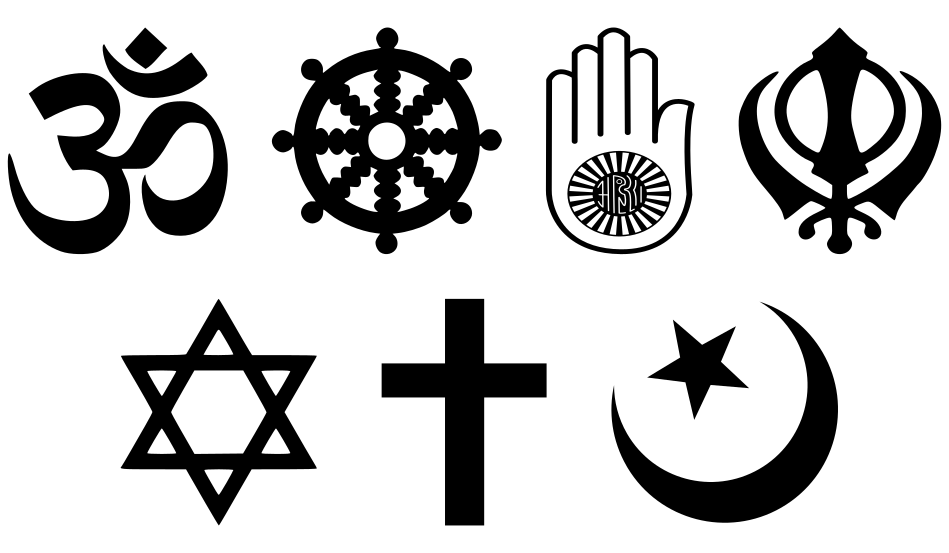
Key idea: Polytheism is the belief in and worship of many gods and goddesses, unlike monotheism which believes in only one god.
Imagine a world where people believe in not just one, but many, many gods and goddesses! That's what is all about. The word "polytheism" comes from two old Greek words: "poly" which means "many," and "theos" which means "god." So, it literally means "many gods."
Long, long ago, a smart Jewish writer named Philo of Alexandria first used this word to talk about how the Greeks believed in many gods. Later, in more recent times, other thinkers like Jean Bodin and Samuel Purchas helped make the word popular again. It's different from , which is when people believe in only one god, like in Christianity or Islam.
Quick check
What is the main difference between polytheism and monotheism?
Key idea: Polytheistic religions often feature a pantheon of gods, each with unique roles and stories, and these gods can be seen as distinct beings or different aspects of a larger divine concept.
In polytheistic religions, people often believe in a whole group of gods, like a big family, called a . Each god in this pantheon might have their own special stories, temples, and ways that people worship them. For example, some gods might be in charge of things like the sun, the ocean, or even love!
Sometimes, these gods are seen as real, separate beings. Other times, people might think of them as different ways to understand one bigger, super-important divine idea. It can be tricky to count gods, because sometimes what looks like many gods might actually be different ways of seeing one main god. For example, in ancient Greece, people worshipped many gods like (king of the gods) and (queen of the gods).
Quick check
What is a 'pantheon' in polytheistic religions?
Key idea: People in polytheistic traditions may not worship all gods equally, sometimes focusing on one main deity while still acknowledging others, a practice known as monolatry or henotheism.
Even when people believe in many gods, they don't always worship all of them equally. Sometimes, people might believe many gods exist but choose to worship only one main god, or a special group of gods. This is called or . It's like having many friends but only inviting your best friend to your birthday party.
For example, the Quran, which is the holy book for Islam, strongly says that believing in many gods is wrong. But some old writings that Judaism and Christianity are based on might have had some ideas about many gods a very long time ago. Even in religions that mostly believe in one god, you can sometimes find ideas that are a bit like polytheism, such as believing in who can help people, or even the idea of a devil like .
Polytheism has been around for a very, very long time! We can see it in the oldest stories and records from places like ancient Egypt and Mesopotamia. It was also a big part of life in ancient Greece and Rome, where people worshipped gods like Zeus and Jupiter.
Today, there are still many religions around the world that are polytheistic. Some examples include and Chinese folk religions, in Japan, and many Traditional African religions. Even some newer religions, like , are polytheistic.
Examples of Polytheistic Religions Today
“Polytheism has been around for a very, very long time!”
Key idea: Soft polytheism sees different gods as aspects of a single divine idea or natural forces, while hard polytheism views each god as a distinct and separate divine being.
Sometimes, people talk about "soft" polytheism and "hard" polytheism. It's like asking if all the characters in a story are completely different, or if they are just different ways of telling the same story.
is when people believe that different gods might be like different faces of one big, main god, or maybe they are just ideas in our minds, or even ways to understand nature. For example, someone might think that the Greek god Zeus, the Norse god Odin, and the Indian god Indra are all just different names for the same powerful sky god.
is when people believe that each god is a truly separate, real, and distinct divine being. They don't think all gods are secretly the same. They might even believe that only the gods in their own religion are real.
Quick check
What is the difference between 'soft' and 'hard' polytheism?
The gods in polytheistic religions are often described as having personalities, just like people! They have feelings, needs, and their own histories. They might have special skills or powers that humans don't have, but they can still be happy, sad, angry, or loving. This is called being , which means having human-like qualities.
Polytheism is also often connected to , which is the belief that spirits live in nature, like in trees, rivers, or animals. In many polytheistic religions, gods are just the most powerful of many different kinds of supernatural beings, which can also include ghosts, spirits of ancestors, or even magical creatures.
Common Types of Deities
“The gods in polytheistic religions are often described as having personalities, just like people!”
Key idea: Mythology provides stories about gods that help people understand their beliefs, but these stories are distinct from the actual practices of worshipping the gods.
Many ancient stories about gods are called "mythology." These stories help people understand their gods and the world around them. For example, the story of Cronus eating his children in Greek mythology might sound strange, but it was a way for ancient people to think about how gods work.
It's important to remember that these stories are different from actually worshipping the gods. People might have stories where gods fight each other, but they would still worship both gods side-by-side. This shows that the stories and the actual religious practices can be different.
Key idea: Hinduism is a complex religion that can be seen as polytheistic, monotheistic, or a blend of both, as many gods are often viewed as different forms of one ultimate divine being (Brahman).
is a very old and diverse religion. Many people think of it as polytheistic because it has so many gods and goddesses, like Vishnu, Shiva, and Lakshmi. But it's actually more complicated than that!
Some Hindus believe that all these different gods are just different ways to see one ultimate, all-powerful divine being called . It's like having many different flavors of ice cream, but they're all still ice cream. Other Hindus might focus on worshipping one main god while still believing other gods exist. So, Hinduism can be seen as polytheistic, monotheistic, or a mix of both, depending on who you ask and which part of Hinduism they follow.
Why does this matter?
- Understanding polytheism helps us learn about different cultures and how people around the world have tried to understand the big questions about life and the universe.
- It teaches us about history, as many ancient civilizations built their societies and art around their polytheistic beliefs.
- It shows us that there are many different ways to think about spirituality and the divine, and that people can have very diverse beliefs.
Ask Baiku anything about this article
Ask a question and Baiku will answer in plain English 🙂
Test yourself
1 / 3What does the word "polytheism" mean?
Keep exploring
Monotheism
Belief that there is only one God

Pantheon (religion)
Collection of gods of a particular religion or mythos

Hinduism
Range of Indian religious traditions

Ancient Greek religion
Religious practices in ancient Greece encompassed a collection of beliefs, rituals, and mythology, in the form of both popular public religion and cult practices.