The one thing to know:
Always switching your choice in the Monty Hall game gives you a much better chance of winning!
TL;DR
- 1You pick one of three doors, hoping for a car, but two have goats.
- 2The host then opens one of the doors you didn't pick, always showing a goat.
- 3It's always better to switch your choice to the other closed door, as it doubles your chances of winning the car.
Think of it like:
Think of it like this: You're playing a game with three cups. Under one cup is a candy, and under the other two are pebbles. You pick a cup. Now, I (the host) look under one of the cups you didn't pick and show you a pebble. If I then ask if you want to switch to the other unchosen cup, you should! That other cup now has a much better chance of having the candy.
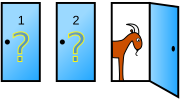
Imagine you're on a fun game show! There are three big doors in front of you. Behind one door is a super cool , and behind the other two doors are not-so-exciting . You really want the car, right? This tricky game is called the , named after a real game show host. It's a famous puzzle about how we think about chances, also known as .
First, you pick one door. Let's say you pick Door #1. You hope the car is behind it! But don't open it yet. The host, who knows where the car is hidden, will then open one of the other two doors (not the one you picked). The host will always open a door that has a goat behind it. So, if you picked the car, the host picks one of the two goat doors. If you picked a goat, the host must pick the other goat door.
After the host shows you a goat behind one of the doors you didn't pick, they ask you a question: "Do you want to switch your choice to the other closed door?" This is the big moment! What should you do?
“The host will always open a door that has a goat behind it.”
It might feel like there are now only two doors left, so your chances are 50/50, right? But that's where the trick is! The smart answer is: YES, you should switch doors! If you switch, you have a 2 out of 3 chance (about 67%) of winning the car. If you stick with your first choice, you only have a 1 out of 3 chance (about 33%).
Why? When you first pick a door, there's a 1/3 chance you picked the car and a 2/3 chance you picked a goat. When the host opens a goat door, they are actually helping you! They are concentrating that 2/3 chance of having picked a goat onto the one remaining closed door you didn't choose. The chance that your first pick was right stays at 1/3. But the chance that the car is behind the other closed door jumps to 2/3!
Many smart people, even professors, found this hard to believe at first! When a writer named explained this in a magazine, she got thousands of letters from people saying she was wrong. Even a very famous mathematician named didn't believe it until he saw a computer show him it was true many times over.
This puzzle is called a because the answer seems totally wrong, but it's actually true! It shows how our brains can sometimes trick us when we think about chances.
“Many smart people, even professors, found this hard to believe at first!”
To make it easier to understand, imagine there are 100 doors instead of 3. You pick Door #1. There's only a 1/100 chance you picked the car. Now, the host opens 98 other doors, all showing goats. Only two doors are left closed: your Door #1 and one other door. Would you stick with your first choice, or switch to the other door? It feels much clearer now, doesn't it? That other door now holds almost all of the 99/100 chance that you didn't pick the car initially.
The rules for the host are very important for this to work. The host must always open a door you didn't pick, always show a goat, and always offer you the chance to switch. If the host could do something different (like only open a door if you picked the car, or open your door right away), then the chances would change. But with the standard rules, switching is always the best strategy!
Why does this matter?
- It teaches you to think carefully about how information changes probabilities, not just guess.
- It helps you understand that sometimes your first guess isn't always the best, even if it feels like it.
- It's a fun puzzle to share with friends and family to see if they can figure out the trick!
Ask Baiku anything about this article
Ask a question and Baiku will answer in plain English 🙂
