The one thing to know:
The Andromeda Galaxy is our closest giant galaxy neighbor, and it's on a collision course with our Milky Way!
TL;DR
- 1The Andromeda Galaxy is a huge spiral galaxy, very similar to our own Milky Way, and it's the closest big galaxy to us.
- 2For a long time, scientists thought it was just a cloud in our galaxy, but we now know it's a separate 'island universe' far away.
- 3Andromeda is heading straight for the Milky Way, and in billions of years, they will crash and merge into one giant galaxy.
Think of it like:
Think of our Milky Way and the Andromeda Galaxy like two giant ships sailing across a vast ocean. They are both huge and full of treasures (stars!), and right now, they are slowly but surely sailing towards each other, destined to meet and become one super-ship.

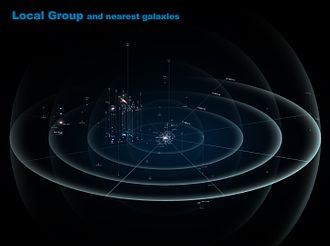
Imagine a giant swirling city of stars, even bigger than our own galaxy! That's the Andromeda Galaxy. It's like our cosmic next-door neighbor, and it's the closest big galaxy to us. People used to call it the Andromeda Nebula, thinking it was just a cloudy patch in our sky. But it's actually a whole separate galaxy, known by other cool names like Messier 31 or M31.
This amazing galaxy is super far away, about 2.5 million from Earth. A light-year is how far light travels in one year, so that's an incredibly long distance! Even though it's so far, it's so big that you can sometimes see it with just your eyes on a very dark night. It looks like a faint, fuzzy smudge in the sky, in the part of the sky called the . This constellation is named after a princess from an old Greek story.
For a long, long time, people didn't know what the Andromeda Galaxy really was. Around the year 964, a Persian astronomer named Abd al-Rahman al-Sufi described it as a 'nebulous smear' or 'small cloud.' This was the very first time anyone wrote about a galaxy other than our own Milky Way!
Later, in the 1600s, scientists started using and saw it better. But even then, they still thought it was just a cloud of gas and dust inside our own galaxy. It wasn't until much later that we figured out its true nature.
"The Andromeda Galaxy is visible to the naked eye in dark skies."
A smart thinker named Immanuel Kant in 1755 had a big idea: he thought our Milky Way might just be one of many 'island universes' floating in space. He guessed that those blurry spots like Andromeda were actually other galaxies, just like ours!
Then, in the early 1900s, a scientist named Edwin Hubble used a powerful telescope to look very closely at Andromeda. He found special stars called in it. These stars blink in a way that helps astronomers figure out how far away they are. Hubble's discovery proved that Andromeda was not a cloud in our galaxy, but a completely separate galaxy, super far away! This was a huge moment in science, showing us how vast the universe really is.
“Hubble's discovery proved that Andromeda was not a cloud in our galaxy, but a completely separate galaxy, super far away!”
The Andromeda Galaxy is a giant, weighing about the same as our Milky Way, which is like a trillion (that's a 1 with 12 zeros!) times the mass of our Sun! It's also really big across, about 152,000 light-years wide. It has a bright center and beautiful that swirl around, just like our Milky Way. It's full of billions of stars, gas, and dust.
Scientists have also found a super big right in the middle of Andromeda, just like there's one in the center of our galaxy. This black hole is incredibly heavy, millions of times the mass of our Sun!
Here's the most exciting part: the Andromeda Galaxy is actually moving towards our Milky Way! It's rushing towards us at about 110 kilometers (or 68 miles) every second. Don't worry though, you won't see it happen tomorrow. Scientists predict that in about 4 billion years, these two giant galaxies will crash into each other.
When they collide, it won't be like two cars smashing. Instead, because space is so huge, the stars themselves probably won't hit each other. The galaxies will slowly pass through each other, pulling and tugging with their , until they eventually merge and become one giant, new galaxy! It might look like a big oval-shaped galaxy instead of a spiral one.
“Scientists predict that in about 4 billion years, these two giant galaxies will crash into each other.”
Just like our Milky Way has smaller galaxies orbiting it, Andromeda also has its own little family of . The two most famous ones are called M32 and M110. Scientists think that M32 might have once been a bigger galaxy that got its outer parts pulled away by Andromeda's strong gravity.
These smaller galaxies also interact with Andromeda, and sometimes their gravity can even cause ripples or warps in Andromeda's beautiful spiral shape.
Why does this matter?
- Understanding Andromeda helps us learn about our own Milky Way, since they are so similar and will one day become one.
- Studying how Andromeda formed and changed helps us understand how all galaxies in the universe grow and evolve over billions of years.
- The future collision with Andromeda is a real cosmic event that will change our galaxy forever, even if it's billions of years away!
Ask Baiku anything about this article
Ask a question and Baiku will answer in plain English 🙂